Skip to content
Greenhouse automation

Polyhouse Automation System built for Indian farms

A polyhouse automation system runs your irrigation, fertigation, fogging, fans, vents and pumps from one panel — manually, on a timer, or off sensor readings. Ours starts at ₹25,000 per unit, handles up to 5 loads on 230 V single phase, and is commissioned by our own crew.

Rated 4.8/5 by 1,842+ farmers

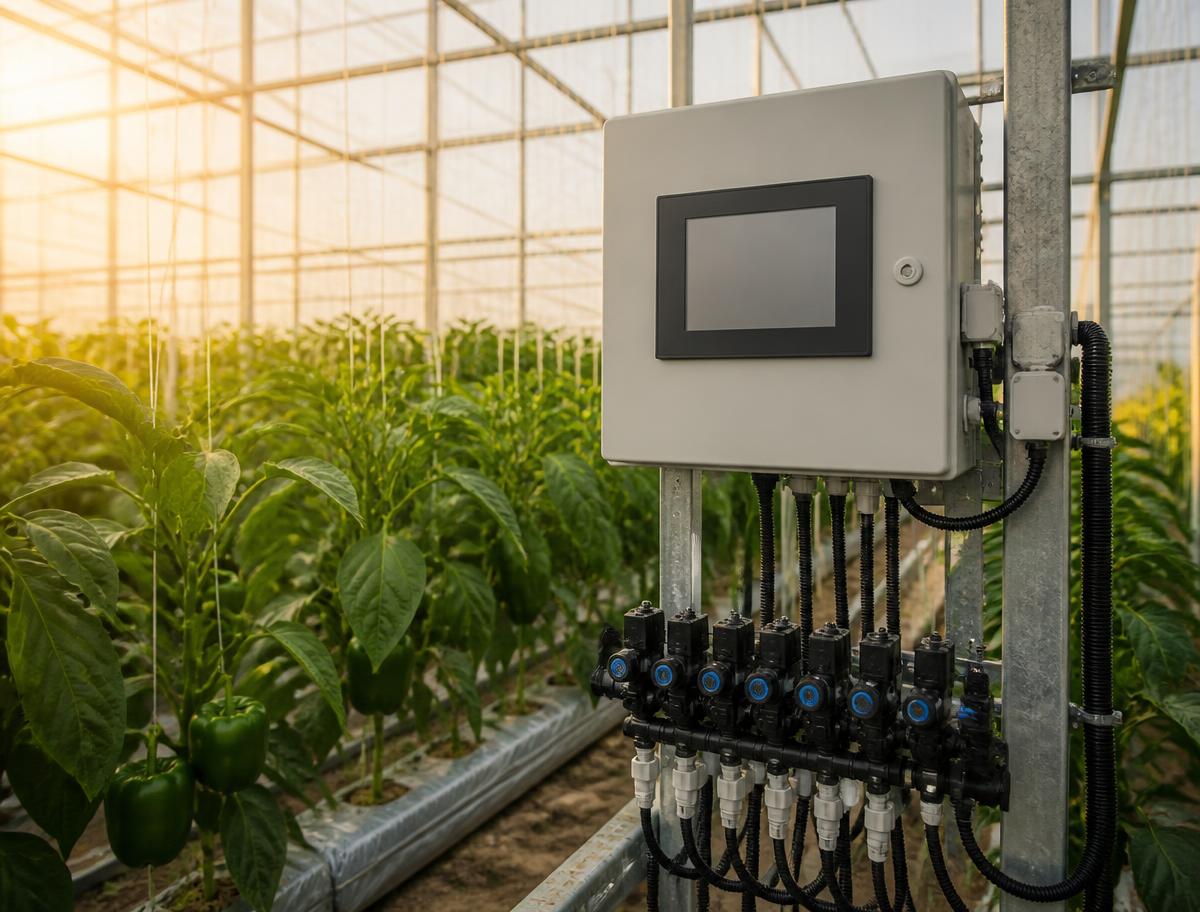
Wall-mounted polyhouse automation control panel with touchscreen and solenoid valve bank inside a capsicum greenhouse

₹25,000 / unit

Price from

Up to 5

Loads

230 V AC, single phase

Supply

2–3 days

Commissioning

Technical specifications

What you get in this system

These are the exact sizes, capacities and materials that go into our field builds. No brochure numbers — everything here is what we have installed in Haryana and western UP.

System type
Embedded
Control method
Manual switch, remote, touch panel, mobile app, voice
Supported protocols
Wi-Fi, Zigbee, BLE, RF
Communication
Modbus RTU, Ethernet
Control platform
HMI, mobile app, dashboard
Panel type
Wall mount
Maximum loads
Up to 5 loads
Power supply
230 V AC, single phase (adapter / solar / battery options)
Inputs
Temperature, humidity, soil moisture, water level, pH, EC (optional)
Outputs
Pump, valve, fogger, fan, vent, alarm
Industry
Agriculture, greenhouse, nursery
Service offered
Design, programming, installation, commissioning
Why this matters

What this system does on your farm

Built from the field notes we have made on hundreds of installs across this belt.

Irrigation and fertigation on schedule

Each block gets its own valve output and its own timing. Set the drip cycle once and the panel runs it — including the venturi or dosing pump, so nutrition goes in at the same strength every day instead of whatever the operator judged that morning.

Temperature and humidity control

Sensors inside the crop canopy drive the foggers and the vent motors. When it crosses your set point in May, the fogging line comes on before the crop wilts. Nobody has to be standing there.

Sensor, timer or manual — your choice

Every output has a manual switch on the panel face. If a sensor plays up or power is unstable, you still open the valve by hand. Automation should never lock you out of your own pump house.

Soil moisture and water level inputs

Moisture probes stop the cycle when the root zone is already wet, and a tank level float stops the pump running dry. Both pay for themselves the first time a pump would have burnt.

Alerts and remote monitoring

Optional GSM or Wi-Fi link pushes alerts when a zone does not build pressure, a tank runs low or a sensor drops out. You see it on the phone from the mandi, not when you next walk the polyhouse.

Programmed for your crop, not a template

We write the schedule around the crop, polyhouse size and your water source. Capsicum in a 1-acre naturally ventilated house does not want the same cycle as gerbera under shade net.

Options

Which size is right for your crop

We do not quote one template. The build is matched to the crop, the season and the water you have.

Timer panel (2 loads)

Small polyhouse or net house, single pump and one drip block

Scheduled irrigation and fogging, manual override. Entry-level build around ₹5,000–₹12,000.

Sensor-based panel (up to 5 loads)

1-acre polyhouse with drip, fertigation, foggers and vents

Temperature, humidity and soil moisture inputs with app control. The common choice, from ₹25,000.

IoT dashboard build

Multi-house farms and contract growers who need records

Cloud dashboard, logging, EC/pH monitoring and alerts. Higher end of the range, up to ₹1,00,000.

Field notes

What we have learned on real farms

These are the mistakes we have seen, and the details that decide whether a system lasts or becomes a maintenance problem.

Power here is the real design constraint

Supply in this belt drops mid-cycle. Every panel we commission is specified to resume its schedule on its own after a cut, and the valves are chosen to fail closed. Without that, the farmer wakes up to a block that flooded all night or one that never ran.

Put the sensor in the canopy, not near the door

The most common mistake we correct is a temperature probe screwed next to the entry, where every opening skews the reading. It belongs mid-house at crop height, shielded from direct sun.

Automate the filter flush too

On hard borewell water around Karnal and Shamli, the disc filter chokes faster than anyone expects. Put the back-flush on the same panel and the system cleans itself instead of losing you a week of pressure.

Process

From survey to handover

How we run this project so the field crew is not guessing on the day.

01

Load list and site check

We list every pump, valve, fogger, fan and vent motor you want on the panel and check your incoming supply and earthing.

02

Panel design and build

Wiring diagram, contactor and relay sizing, enclosure layout. Panel is built and bench-tested before it reaches your farm.

03

Installation and programming

Mounting, cabling, sensor placement, then the schedule is programmed with you standing there so you know what each button does.

04

Handover and training

Operator training in Hindi, a printed sequence stuck on the pump-house wall, and our number for whenever it behaves oddly.

What is included

  • Control panel with enclosure, contactors and manual overrides
  • Programming for your crop and block layout
  • Sensor mounting and calibration
  • Installation, cabling and commissioning
  • Operator training in Hindi

Not included

Honest exclusions so you can budget the full project, not just the headline price.

  • Solenoid valves, foggers and vent motors, unless quoted with the panel
  • Civil work and earthing pit, if your site does not already have one
  • Cloud dashboard subscription, where an IoT build is chosen
  • Solar or battery backup, quoted separately by site load

Subsidy and government scheme support

Automation is generally taken up as part of a protected-cultivation or micro-irrigation project rather than on its own. Where you are applying under PMKSY per-drop-per-crop, MIDH or the state horticulture programme, we prepare the technical layout and estimate that the file needs and coordinate with the horticulture office. Assistance rates change by year and district, so confirm the current rate with them.

FAQ

Common questions

Short, direct answers written for how farmers search on Google.

What is a polyhouse automation system?

It is a control panel that operates the equipment inside a polyhouse — irrigation valves, fertigation injector, foggers, exhaust fans, ridge vents and the pump. It runs on a timer, on sensor readings, or manually. The point is that the climate and irrigation stay steady even when nobody is at the farm.

How much does a polyhouse automation system cost in India?

Our panels start around ₹5,000 for a simple two-load timer and go up to ₹1,00,000 for a fully sensored multi-zone build with an IoT dashboard. A typical one-acre polyhouse with drip, fertigation, fogging and vents lands near ₹25,000–₹30,000, installed and programmed.

Can I control it from my mobile?

Yes. The panel supports mobile app control over Wi-Fi or GSM, plus touch panel, remote and voice control. You can open a block, change a schedule or check whether the last cycle ran without being on the farm.

What happens during a power cut?

Valves fail closed and the panel resumes its schedule once supply returns, so a cut in the middle of a cycle does not leave a block flooded or dry. Where supply is very unstable we add battery or solar backup for the controller itself.

Which sensors can be connected?

Temperature, humidity, soil moisture, water level, and pH or EC where fertigation accuracy matters. Sensors are optional — many farms start with a timer panel and add probes later, since the wiring is provisioned for it from day one.

Does it work with my existing drip and fertigation setup?

In most cases yes. We check your existing valves, injector and pump starter, then wire them into the new panel. Only manual gate valves need replacing with solenoids, and that is a small line item compared with rebuilding the head unit.

How long does installation take?

Two to three days on site for a standard one-acre polyhouse, once the panel arrives bench-tested. That includes cabling, sensor placement, programming and operator training. Larger multi-house farms take about a week.

Do you provide service after installation?

Yes — 24×7 on phone and WhatsApp. Send a photo of the panel display and most faults get diagnosed the same evening. Where hands are needed a technician comes out, same day inside Karnal district wherever we can manage it.

Get a site-specific quote

Tell us your acreage, crop and water source. We'll come out, measure, test and give you an itemised quote with the subsidy path included.