Skip to content
Protected cultivation

Net House Structure shade & insect netting

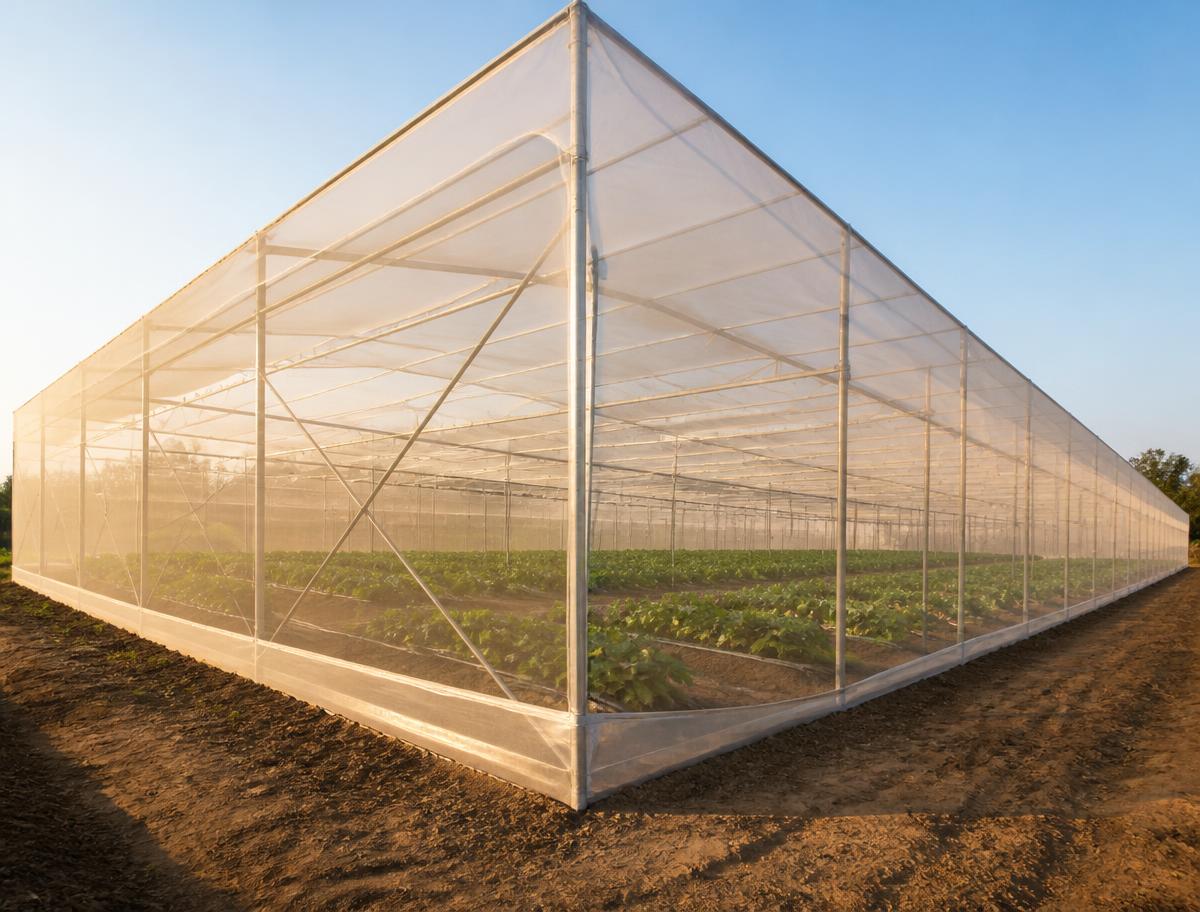
A net house is a galvanised steel frame covered with insect or shade net, letting through only the light, heat and air the crop needs. A 1-acre single-layer cable-purlin net house starts at ₹14,92,025 (₹364.62/sq m), with NHB subsidy of ₹355/sq m available.

Rated 4.9/5 by 1,566+ farmers

Galvanised steel net house structure covered with white insect netting over rows of vegetable crops

₹14,92,025 / acre

Cost from

from ₹17,77,646 (double layer)

After NHB subsidy

Galvanised steel

Frame

15 / 35 / 40 / 50 / 75 / 90%

Shade factors

Technical specifications

What you get in this system

These are the exact sizes, capacities and materials that go into our field builds. No brochure numbers — everything here is what we have installed in Haryana and western UP.

Structure material
Galvanised steel pipe
Covering material
Polyethylene insect net / shade net
Shade factors available
15%, 35%, 40%, 50%, 75%, 90%
Roof types
Flat roof and dome shaped
Purlin options
Cable purlin, pipe purlin
Layers
Single layer or double layer with secondary net
Secondary layer options
White shade net 50%, Aluminet 50%
Included works
Structure, trellising, installation
Irrigation
Drip and fogger compatible
Application
Vegetables, nursery, flowers, exotic crops
Why this matters

What this system does on your farm

Built from the field notes we have made on hundreds of installs across this belt.

Shade factor picked for the crop, not the catalogue

A 40% net blocks 40% of the light and lets 60% through. Capsicum and cucumber want 35–50%. Nursery and shade-loving crops go to 75%, and 90% is for hardening and short-term cover. Choose wrong and you either cook the crop or starve it of light.

Insect net that actually keeps thrips out

For virus-prone crops the mesh count matters more than the shade percentage. We use a 40-mesh insect net on the sides and doors where whitefly and thrips pressure is high, with a double-door entry so the house does not open straight into the field.

Cable purlin or pipe purlin

Cable purlin is the affordable build and works well in low wind zones. Pipe purlin costs more but holds shape under load and lasts longer in the open, wind-swept plots common across Haryana. We quote both so you can see the gap.

Flat roof or dome

Flat roof shade net houses are the cheaper, faster build and handle light regulation well. Dome shaped houses shed rain and dust better and give more headroom for trellised crops. Both sit on the same galvanised frame.

Trellising built in

The quoted rates already include trellising — the wires and supports your tomato, cucumber or capsicum crop will be tied to. It is not a later add-on, because retrofitting it inside a finished house is slow and expensive.

Drip and fogger ready

The layout is set out so drip laterals, submains and fogger lines run cleanly along the bays. We fit the head unit, filtration and fertigation inside the same project rather than sending you elsewhere for it.

Pricing

Cost of a 1-acre net house

Rates for a complete 1-acre net house in India — structure, trellising and installation included. Prices are inclusive of GST and may change with location, working conditions and farmer requirements.

TypeRate per sq mTotal for 1 acre

Single layer cable purlin net house

Structure + trellising + installation

₹364.62₹14,92,025

Double layer cable purlin net house

Structure + secondary layer (white shade net 50%) + trellising + installation

₹394.12₹16,12,740

Double layer cable purlin — Aluminet secondary

Structure + secondary layer (Aluminet 50%) + trellising + installation

₹518.02₹21,19,738

Double layer pipe purlin net house

Structure + secondary layer (white shade net 50%) + trellising + installation

₹789.42₹32,30,306

National Horticulture Board subsidy

Assistance against the eligible cost

₹355 / sq m− ₹14,52,660*

Net investment, pipe purlin net house after subsidy

What actually leaves your pocket

₹17,77,646*

*All prices inclusive of GST. Subsidy is released according to NHB guidelines; terms and conditions apply and rates are revised from time to time. These are tentative figures and change with location, working conditions and farmer requirements.
Options

Which size is right for your crop

We do not quote one template. The build is matched to the crop, the season and the water you have.

15–35% shade

Winter vegetables, hardening, light regulation only

Minimum light loss, mostly used where insect exclusion is the real goal.

40–50% shade

Capsicum, cucumber, tomato, exotic vegetables

The workhorse range for commercial vegetable growers in Haryana and western UP.

75% shade

Nursery, leafy greens, propagation

Keeps bed temperature down through May and June; pair with fogging.

90% shade

Short-term hardening, storage and shade yards

Too dark for a full cropping cycle — used as a secondary or seasonal cover.

Field notes

What we have learned on real farms

These are the mistakes we have seen, and the details that decide whether a system lasts or becomes a maintenance problem.

The net fails before the steel does

A galvanised frame will stand for a decade. The net is the consumable — UV degradation, monsoon load and dust abrasion decide whether you replace it in year three or year six. Buy the heavier net; the extra cost is small against a re-covering job.

Wind zone decides purlin type

On the open plots between Karnal and Jind the wind comes across without a break. On those sites we push farmers toward pipe purlin even though it costs more per square metre — a cable purlin roof that lifts once takes the crop with it.

Double door, always

Farmers ask us to save money by dropping the entry chamber. We do not. A single door into a virus-prone crop undoes the whole point of an insect net, and thrips walk in every time somebody carries out a crate.

Process

From survey to handover

How we run this project so the field crew is not guessing on the day.

01

Survey and layout

Plot measurement, levelling check, wind direction, water source and the crop plan. Bay orientation follows the prevailing wind, not the plot boundary.

02

Design and itemised quote

Frame drawing, purlin type, shade factor and net specification, trellising layout, then a quote priced line by line with the subsidy path shown.

03

Foundation and structure

Foundation pits, galvanised column erection, purlins and cabling. Trellis wires go up with the frame while access is still easy.

04

Netting, drip and handover

Net fixing with proper tensioning and profiles, double-door entry, drip and fogger lines, then a walkthrough of maintenance.

What is included

  • Galvanised steel frame with foundation work
  • Shade or insect netting with fixing profiles
  • Trellising wires and supports
  • Double-door entry chamber
  • Installation by our own crew
  • Subsidy file: layout, estimate and documentation

Not included

Honest exclusions so you can budget the full project, not just the headline price.

  • Land levelling beyond minor grading
  • Boundary fencing and approach road
  • Electrical supply extension to the site
  • Drip, fertigation and fogging, unless quoted in the same project

Subsidy and government scheme support

Net houses are covered under the National Horticulture Board and MIDH programmes; the NHB rate reflected above is ₹355 per square metre against eligible cost. State horticulture departments in Haryana and Uttar Pradesh run their own top-ups. We prepare the technical layout, estimate and documentation your application needs and coordinate with the district horticulture office. Assistance is released per NHB guidelines and rates are revised periodically — confirm the current rate before you budget.

FAQ

Common questions

Short, direct answers written for how farmers search on Google.

What is a net house?

A net house is a protected cultivation structure: a galvanised steel frame covered with polyethylene shade or insect net instead of film. The net lets through a controlled share of light, heat and air, so the crop grows in steadier conditions while insects and hail are kept off it.

What is the cost of a 1-acre net house in India?

A single-layer cable purlin net house starts at ₹364.62 per square metre, about ₹14,92,025 for one acre including structure, trellising and installation. Double-layer builds run from ₹16,12,740 to ₹32,30,306 depending on purlin type and secondary net. All figures include GST and are tentative.

How much subsidy is available on a net house?

The National Horticulture Board rate reflected in our costing is ₹355 per square metre, roughly ₹14,52,660 for an acre against eligible cost. After that, a double-layer pipe purlin net house works out to about ₹17,77,646 net. Terms apply and rates are revised, so confirm with your horticulture office.

Which shade factor should I choose?

A 40% net blocks 40% of light. Capsicum, cucumber and tomato do well at 35–50%. Nursery and leafy crops prefer 75%. 90% is for hardening and shade yards, not a full crop cycle. We pick the factor from your crop, sowing window and how exposed the plot is.

What is the difference between a net house and a polyhouse?

A polyhouse is covered in UV-stabilised poly film and traps heat, which suits winter cropping and full climate control. A net house is covered in net — cheaper, cooler, better ventilated, and aimed at shade regulation and insect exclusion rather than temperature control.

How long does a net house last?

The galvanised frame typically lasts ten years or more. The net is the consumable and usually needs replacing every three to five years depending on UV exposure, dust and monsoon load. Heavier nets and correct tensioning are what push that towards the upper end.

Which crops are grown in a net house?

Capsicum, cucumber, tomato, chilli, exotic vegetables, leafy greens, nursery seedlings and cut flowers. In this belt the money is usually in off-season vegetables sold into Delhi mandis, where protected cultivation lifts both yield and grade.

How long does construction take?

About 30 to 40 days for a one-acre net house from foundation to handover, assuming the site is level and the weather holds. Monsoon slows the concrete work. We give you a date at quotation stage and tell you early if anything slips.

Get a site-specific quote

Tell us your acreage, crop and water source. We'll come out, measure, test and give you an itemised quote with the subsidy path included.