Skip to content
Polyhouse farming

Naturally Ventilated Polyhouse 8 m span, GI structure

A naturally ventilated polyhouse cools itself through side and top vents instead of fans and pads. Ours is a hot-dip galvanised GI pipe frame, 8 m span, 5 m peak height, poly film cover with drip and fogger inside — from ₹1,000 per square metre, built for vegetable and flower farming.

Rated 4.9/5 by 1,810+ farmers

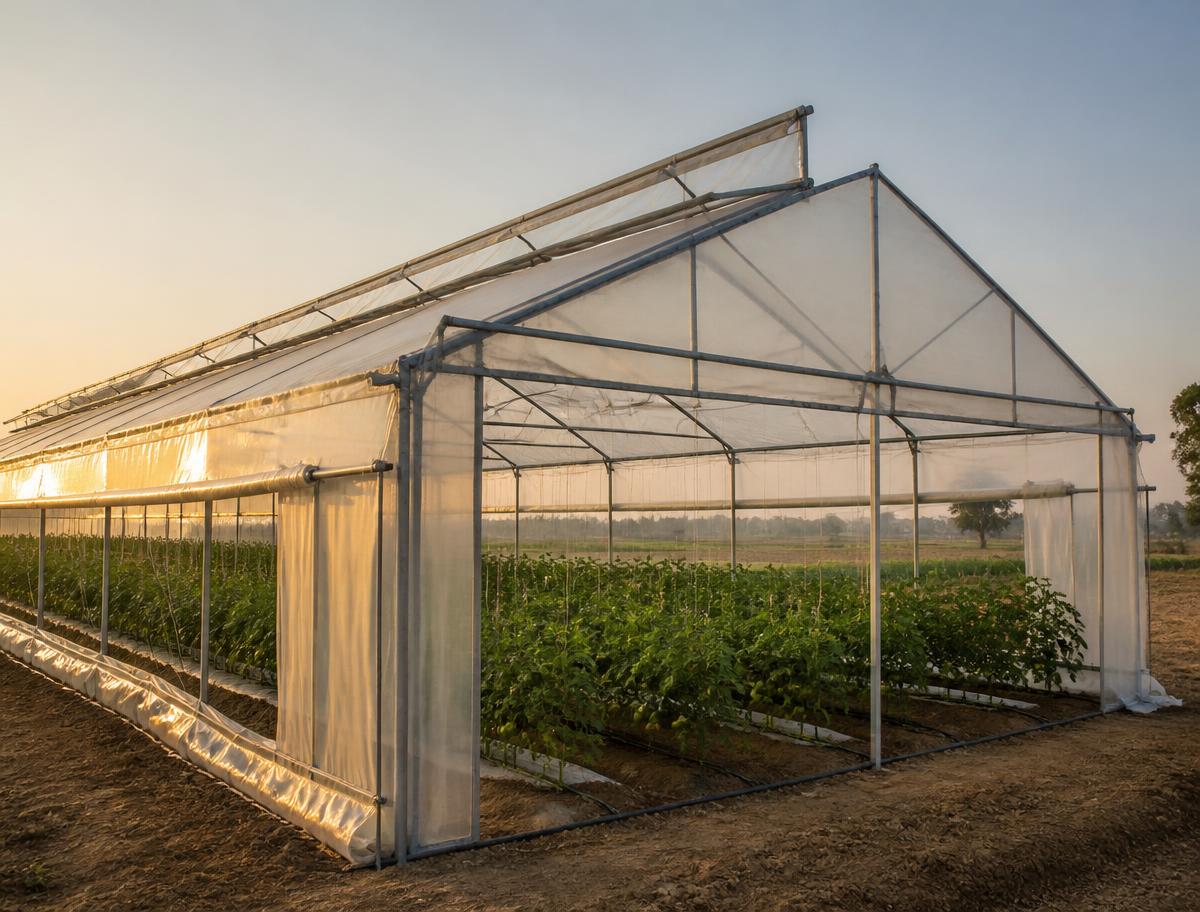
Naturally ventilated polyhouse with galvanised GI pipe frame, open top vents and roll-up side vents over a tomato crop

₹1,000 / sq m

Price from

8 m

Span

5 m

Peak height

~45 days / acre

Build time

Technical specifications

What you get in this system

These are the exact sizes, capacities and materials that go into our field builds. No brochure numbers — everything here is what we have installed in Haryana and western UP.

Greenhouse type
Naturally ventilated
Structure material
GI pipe
Frame coating
Hot dip galvanized
Covering material
Poly film
Span
8 m
Peak height
5 m
Ventilation type
Side and top vent
Irrigation system
Drip, fogger
Application
Vegetable farming, flower farming
Country of origin
Made in India
Why this matters

What this system does on your farm

Built from the field notes we have made on hundreds of installs across this belt.

Ventilation that works without electricity

Hot air leaves through the ridge vent, cooler air enters through the roll-up sides. No fans, no pad, no running cost. On a 5 m peak the stack effect is strong enough to hold the house within a few degrees of outside through most of the season.

8 m span, 5 m peak — chosen for heat

Low-roof polyhouses cook in June. The 8 m span with a 5 m peak gives the air volume that keeps crop-level temperature workable, and the headroom that trellised tomato and capsicum need by mid-season.

Hot-dip galvanised GI frame

Hot dip, not painted or pre-galvanised sheet. That is what decides whether the columns are sound in year eight, especially where fertigation salts and monsoon humidity attack the base of the pipe.

UV-stabilised poly film and insect net

200-micron UV-stabilised film on the roof, 40-mesh insect net on the vents and sides. Film is the consumable, replaced every four to five years; the frame carries on.

Drip and fogging fitted inside the build

Laterals, submain, filtration and fogger lines go in as part of the same project, laid out with the bays rather than squeezed in afterwards. Fertigation head unit is added where the crop justifies it.

For vegetables and flowers that pay

Capsicum, cucumber, tomato, exotic vegetables and cut flowers — crops where off-season pricing repays the structure. We will tell you before quoting if your intended crop will not.

Options

Which size is right for your crop

We do not quote one template. The build is matched to the crop, the season and the water you have.

Naturally ventilated, 8 m span

Most vegetable and flower growers in Haryana and western UP

From ₹1,000/sq m. No running cost on ventilation. The default recommendation for this belt.

Fan and pad polyhouse

High-value crops needing tight temperature control, hotter districts

Around ₹1,500/sq m plus electricity. Justified for gerbera, rose and exotic crops with a firm buyer.

Naturally ventilated greenhouse (larger bay)

Multi-acre commercial projects

Around ₹1,000/sq m; bay width and gutter height set by crop and machinery access.

Field notes

What we have learned on real farms

These are the mistakes we have seen, and the details that decide whether a system lasts or becomes a maintenance problem.

Gutter height is not where farmers should economise

The cheapest quotes in the market win by dropping the peak. It looks like the same polyhouse in the photo and behaves completely differently in June — crop stalls, flowers drop, and you spend the saving on fogging that cannot keep up.

Orient the ridge across the prevailing wind

We set the ridge so the top vent works with the wind that comes off the fields here, not with the plot boundary. It costs nothing at layout stage and is impossible to fix later.

Check the water before the structure

Iron and silt in borewell water around Karnal and Shamli kill emitters inside a season. We take a sample before quoting and size the sand and disc filtration off the result, not off a standard package.

Process

From survey to handover

How we run this project so the field crew is not guessing on the day.

01

Free field survey

Plot measurement, levelling, wind direction, pump flow reading and a water sample. Crop plan decides span, height and vent size.

02

Design and itemised quote

Structural layout, film and net specification, drip and fogging design, and a quote priced item by item alongside the subsidy path.

03

Foundation and GI structure

Foundation pits and concreting, hot-dip galvanised column erection, arches, purlins, gutters and vent mechanisms.

04

Film, drip and handover

Film fixing and tensioning, insect net, foggers, internal drip and fertigation, then a run-through of each block with you before handover.

What is included

  • Hot-dip galvanised GI pipe structure with foundation
  • 200-micron UV-stabilised poly film and 40-mesh insect net
  • Side roll-up and top ridge ventilation with gearing
  • Gutters, drainage and internal drip layout
  • Fogging line where the crop plan calls for it
  • NHB / MIDH subsidy documentation prepared

Not included

Honest exclusions so you can budget the full project, not just the headline price.

  • Land levelling beyond minor grading, and boundary fencing
  • Borewell, pump and power line to the site
  • Fertigation head unit, if not quoted with the project
  • Planting material, media and crop inputs

Subsidy and government scheme support

Protected cultivation is supported under MIDH, the National Horticulture Board and the Haryana and Uttar Pradesh state horticulture programmes, and the drip inside it under PMKSY per-drop-per-crop. Assistance levels change by year, category and district, so we do not quote a percentage. We prepare the technical layout, estimate and documents your application needs and coordinate with the district horticulture office; you confirm the current rate with them.

FAQ

Common questions

Short, direct answers written for how farmers search on Google.

What is a naturally ventilated polyhouse?

It is a polyhouse cooled by air movement instead of machinery. Hot air escapes through a ridge vent at the top while cooler air enters through roll-up side vents, so no fans or cooling pads are needed. It costs less to build and nothing to ventilate.

What does a naturally ventilated polyhouse cost?

From about ₹1,000 per square metre for the structure with poly film, vents and internal drip. A fan-and-pad polyhouse of the same span runs closer to ₹1,500 per square metre, plus the electricity to run it. Final cost depends on span, site levelling and internal fittings.

What span and height do you build?

Our standard is an 8 metre span with a 5 metre peak height, side and top vents. That combination gives the air volume needed to hold crop-level temperature down in May and June, and the headroom trellised tomato and capsicum need late in the cycle.

Naturally ventilated or fan and pad — which should I choose?

For most vegetable growers in Haryana and western UP, naturally ventilated is enough and it saves a large share of both build and running cost. Fan and pad is worth it for gerbera, rose and exotic crops that need tight temperature control and have a firm buyer.

How long does a polyhouse take to build?

About 45 days per acre, covering foundation, GI structure, film, net, vents and internal drip. Monsoon slows the concrete work. We commit to a date at quotation stage and flag any slippage early rather than at handover.

How long do the structure and film last?

The hot-dip galvanised GI frame lasts ten years and more with basic care. The 200-micron UV-stabilised film is a consumable and is normally replaced every four to five years. Re-filming is a straightforward job that does not disturb the frame.

Which crops suit a naturally ventilated polyhouse?

Capsicum, cucumber, tomato, chilli, exotic vegetables and cut flowers. The growers who do best sell off-season into Delhi mandis or to contract buyers, where the price premium pays back the structure. Low-value field crops rarely justify the build cost.

Is subsidy available on a polyhouse?

Yes — protected cultivation is covered under MIDH, NHB and the Haryana and UP state horticulture programmes, with the drip inside it eligible under PMKSY. Rates change by year and district. We prepare the layout, estimate and documentation and coordinate with the horticulture office.

Get a site-specific quote

Tell us your acreage, crop and water source. We'll come out, measure, test and give you an itemised quote with the subsidy path included.